

Rick Rubin has produced more platinum albums than almost anyone alive. Red Hot Chili Peppers. Johnny Cash. Beastie Boys. Kanye West. Adele. System of a Down. The list reads like a museum of iconic sound.
Yet in every interview, he says the same thing: “I’m not a musician.”
To Rick Beato, he gets even more specific:
“If we went to a studio I could not run a session myself. I couldn’t record it. I can’t do their job. I can’t sub for them. I can’t get by. I cannot do those jobs.”
The man who tells engineers where to place the microphone claims he doesn’t know how microphones work. The producer who greenlit Johnny Cash’s American Recordings by saying ‘record everything raw’ insists he can’t run a session.
And everyone believes him. Musicians, engineers, interviewers.
Watch any interview. You’ll never notice what’s happening. You think you’re learning about his production philosophy. But there’s a second conversation running underneath. While you’re tracking his words, his disclaimers are rewiring your defenses.
Rubin doesn’t eliminate his authority. He weaponizes his lack of it.
Every “I’m not,” every “I can’t,” every disclaimer operates as precision engineering. Listen to any thirty-minute conversation. Count the disclaimers. The pattern is unmistakable.
You’ve fallen for it every time you’ve watched him. Andrew Huberman walked away satisfied without getting concrete answers. Rick Beato challenged the contradictions and still accepted them. Understanding these patterns transforms you from viewer to player. Once you see them, you can use them.
After reading this, you’ll see it everywhere. Even knowing about it won’t stop it from working.
Pattern #1: The Authority Inversion
Position Below, Lead From There
Here’s what Rick does unconsciously:
He disclaims expertise (genuinely) then directs everything from that lower position.
Watch it happen:
Beato, himself a producer with forty years in studios, asks about Rick’s technical knowledge. Rick’s response arrives without hesitation:
“I don’t know anything about equipment. I don’t. I don’t. If we went to a studio I could not run a session myself. I couldn’t record it. I can’t do their job. I can’t sub for them. I can’t get by. I cannot do those jobs.”
Count the repetitions. “I don’t. I don’t.” “I can’t. I can’t. I cannot.” That’s belief hammering itself into your brain.
While literally running every session.
Making every creative decision.
Directing engineers on exactly what to capture.
About musicianship, talking about the Chili Peppers:
“That’s why I say I’m not a musician. There’s some of the best musicians in the world. Chad, Flea and John, those three musicians. I don’t know that you can find better musicians than those three musicians.”
He elevates them to “best musicians in the world” while positioning himself outside the category.
Then he tells them what to play.
When Rick says “I can’t run a session,” the threat disappears. You’re not being lectured by an authority. You’re hearing from someone who respects your domain.
So when his creative direction comes, you’re receptive to it.
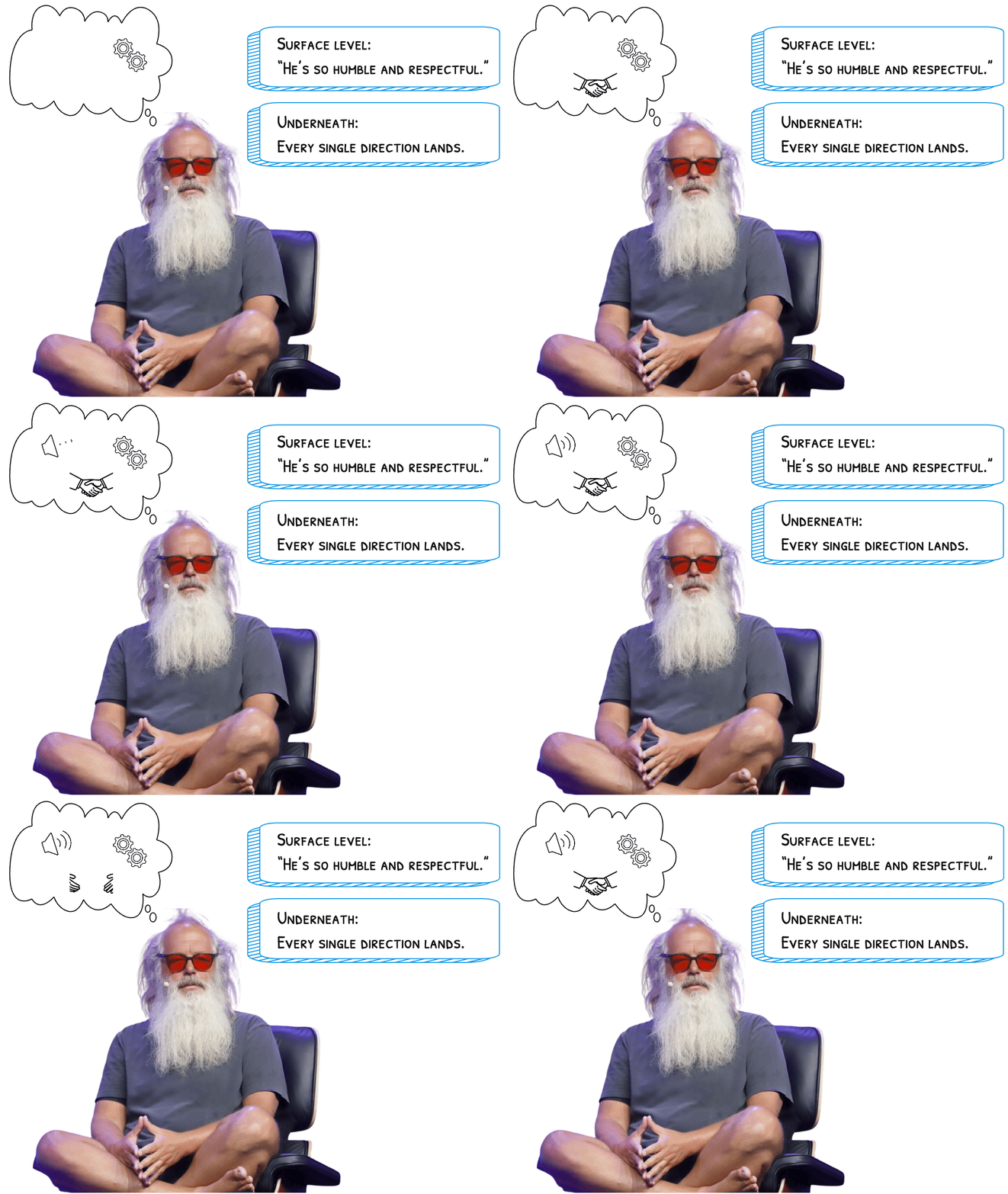
The humility removes the barrier. His creative vision lands because there’s no ego collision.
The Power of this Pattern
This unconscious pattern operates completely outside his awareness.
Rick thinks he can’t do what engineers do. He’s right. He can’t operate the gear at their level. But what he CAN do is hear what’s working and what isn’t. He makes the creative decisions that matter.
He’s positioned himself below on technical skill while operating above on creative vision. The disclaimer removes the threat. So when Rick says “I’m hearing something in that take” or “could we try this differently?” the engineer thinks “let me help this guy get what he needs” instead of “this producer is stepping on my toes.”
The humility makes you want to collaborate. That’s how he gets exactly what he’s hearing without triggering resistance.
Influence through collaboration, not compliance through hierarchy.
How to spot it:
Watch for: “I’m not...” “I can’t...” “I don’t know...” followed by expert-level execution
Count: Disclaimers per conversation (Rick averages one every 3-4 minutes)
Notice: He never circles back to claim competence. Stays in the lower position permanently.
Use this yourself:
When influencing peers or managing up:
“I don’t have the technical depth you do, but what I’m noticing in the data is...”
“I can’t run SQL queries like your team can, but here’s what stands out in these results...”
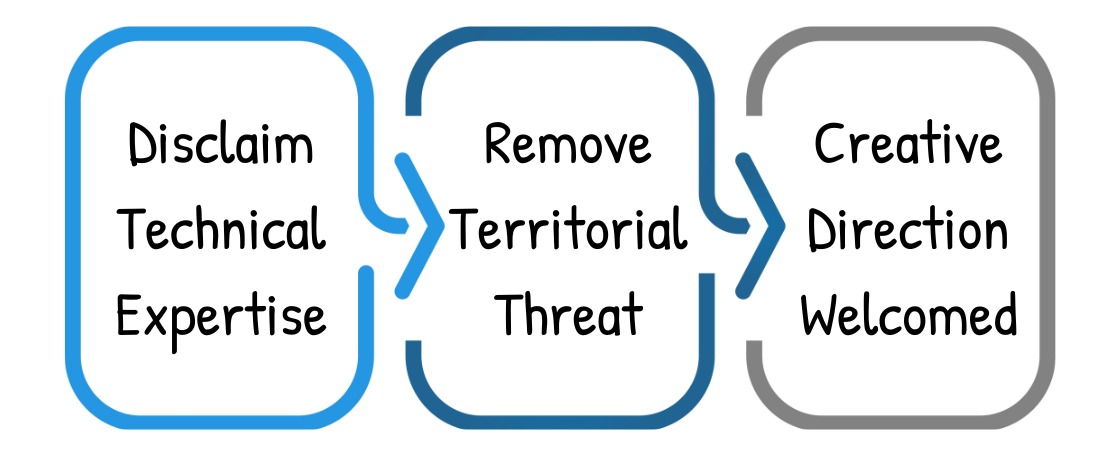
The Formula:
“I can’t do X” (removes the threat) + While doing X (collaborative direction) = You stay open + His creative vision lands
You’ve just learned one of five patterns Rick runs simultaneously. At the end of this article, I’ll show you how to extract YOUR version of these patterns: the ones you’re already using unconsciously that make people lean in when you talk.
The Supporting Patterns
The Authority Inversion is just the beginning. Rick runs four other patterns simultaneously, each reinforcing the others.
Pattern #2: The Paradox He Can’t See
Generate contradictions without recognizing them
The contradiction in “I don’t know equipment” gets even stranger.
Beato pushes back: “But you know what the gear is. You know the difference between a Neve and an API.”
Rick responds: “I do because I’ve been in places with both of them yes. But it doesn’t matter.”
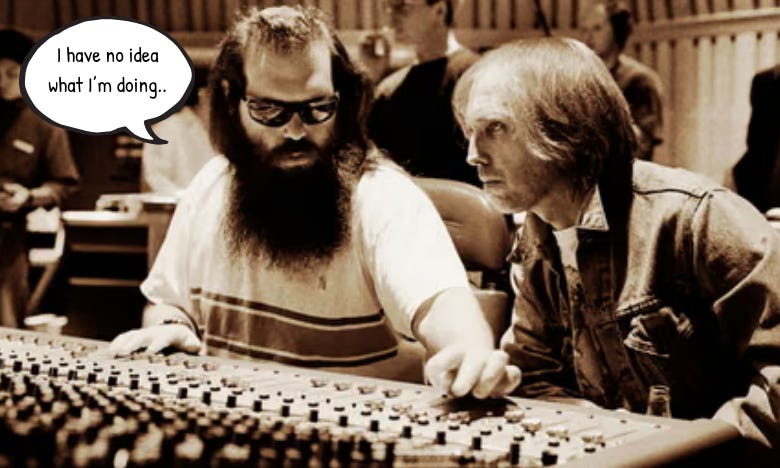
He just contradicted himself. Admitted he DOES know the gear. Then pivoted to “it doesn’t matter” instead of resolving the paradox.
Your brain does something fascinating here. It makes him MORE sophisticated, not less credible.
You think: “He knows but the knowledge isn’t about technical specs. There’s something deeper happening.”
Unresolved paradox signals depth.
“I don’t know equipment” + demonstrates equipment knowledge = your brain thinks “they’re operating beyond my level” instead of “they’re contradicting themselves.”
This protects Rick’s methodology. He can’t be pinned down to simple explanations. The both/and thinking reads as sophistication, not confusion.
What Rick gains:
Maintains mystique. Avoids being reduced to concrete methodology. The paradox becomes proof of sophistication rather than inconsistency.
How to spot it:
Listen for: Two opposing statements in same conversation
Watch for: No acknowledgment of the contradiction. He pivots instead of resolving.
Notice: When “but” or “though” should appear to reconcile, but doesn’t
Use this yourself:
When positioning unique value that doesn’t fit traditional boxes:
“I don’t write code, but I’ve architected systems used by millions of users”
“I’m not a designer, but the interfaces I spec consistently convert at 40%”
Don’t resolve the paradox. Let them hold both truths. The contradiction reads as nuance, not inconsistency. It signals you’re operating in a space that transcends the either/or framework they’re trying to use.
Pattern #3: The Dream State Deflection
Replace concrete method with poetic abstraction
Huberman asks him directly: “How do you access creativity?”
Rick’s answer:
“I think the best way to think about it is like a dream. It’s like, if you think about your dreams, they don’t necessarily make sense. When you wake up, you might remember part but not the whole thing... we’re making things, and we’re looking for feeling in ourselves.”
Huberman, a neuroscientist trained to extract mechanisms, walks away satisfied.
Rick gave him a metaphor, not a method. Zero actionable steps. Pure abstraction.
Your brain processes metaphor as wisdom. The poetic language triggers a “profound insight” response. You fill in the blanks with your own meaning. You feel understood without being constrained by actual methodology.
And here’s what Rick gains: He can’t be proven wrong. Can’t be reduced to a checklist. Can’t have his process commoditized.
The metaphor lets everyone project their own understanding onto it. A songwriter hears “follow feeling” and applies it to lyrics. A designer hears it and applies it to visual composition. The abstraction works for everyone because it’s specific to no one.
What Rick protects: His actual unconscious process. If he gave you five concrete steps, you could follow them and potentially get the same results. The dream metaphor preserves the mystery. You leave feeling like you learned something while his actual methodology remains completely intact.
How to spot it:
Listen for: “It’s like a dream...” “Think of it as...” “The best way to describe it is...”
Count: Metaphors vs. concrete steps (Rick gives 5-10 metaphors per interview, zero step-by-step processes)
Notice: You walk away feeling enlightened without gaining actionable methodology
Use this yourself:
When asked to explain expertise you can’t (or won’t) articulate in steps:
Client: “What’s your process for finding product-market fit?”
You: “Think of it like tuning an instrument. You’re listening for resonance between what you’re saying and what they’re hearing. Sometimes you can feel the disconnect before you can explain why—the messaging is technically correct but something’s slightly off. You adjust based on that feedback, sensing when you’ve hit the right frequency. It’s less about following steps and more about developing an ear for when it clicks.”
Formula:
Replace “Here are the 5 steps” with “It’s like [evocative metaphor]... you’re sensing [feeling-based language].”
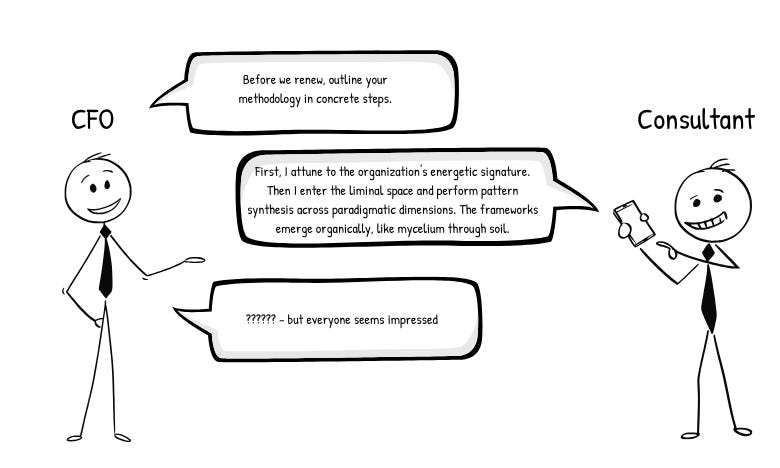
They create their own meaning, feel satisfied, and your actual process stays protected. They can’t commoditize what you won’t specify.
Later, I’ll give you the exact AI prompts that extract these patterns from YOUR conversations: the specific phrases you use that make clients trust you without knowing why.
Pattern #4: The Question Transplant
Answer the question you wish they’d asked
Beato asks: “When did you know that you had this gift for being a music producer?”
Rick answers: “I didn’t. I never knew that. I first connected with music, I want to say it was about 3 years old...”
He answered “when did you connect with music” instead of “when did you know you had producing gift.”
The redirect happens in the same territory. Your brain gets AN answer. Doesn’t notice it wasn’t THE answer. Satisfaction comes from receiving something substantive, not from precision.
Here’s what Rick avoids:
Questions he can’t or won’t answer. The original question implies self-awareness about his gifts. But Rick genuinely doesn’t think in those terms. He can’t answer “when did you know” because he never did know.
So he redirects to what he CAN answer authentically: his love of music. Same general territory (music origins), but a question he has an answer for. You get a real story. He stays in his comfort zone. Everyone walks away satisfied.
What Rick gains:
Controls the narrative without seeming evasive. Appears to answer while avoiding questions that would expose gaps in self-knowledge or methodology. The redirect keeps him in territory where he’s genuinely comfortable and authentic.
How to spot it:
Track: Write down the question asked, then compare to what actually got answered
Listen for: “What I’ve found is...” “The way I think about it...” (redirect signals)
Test: Can you quote the original question after his answer? (Usually no. You forgot within 30 seconds.)
Use this yourself:
When asked something you can’t or won’t answer directly:
Client: “What’s your pricing model?”
You: “What I’ve found is most clients care less about the model than about ROI. Here’s how we think about value creation...”
Or when question has a false premise:
“Why is your process slower than competitors?”
You: “The interesting thing is speed and quality aren’t in tension. What we’ve found is...”
The Question Transplant Formula:
Reframe Signal + Challenge Premise/Redirect Focus + Answer Better Question
Reframe Signals:
“What I’ve found is...”
“The interesting thing is...”
“Here’s what matters more...”
“The real question is...”
Structure:
Don’t answer their question
Signal the redirect (”What I’ve found is...”)
Reframe the premise (pricing → ROI, speed → quality)
Answer the question you want (value creation, not pricing model)
Acknowledge the territory. Answer the better question. They walk away satisfied without you addressing the problematic framing. You stay in control while appearing cooperative.
Pattern #5: The Praise Deflection Reflex
Cannot hold compliments. Instant redirect to others.
Beato: “That is an amazing song” (referring to Blood Sugar Sex Magic)
Rick, instantly: “You have to also keep in mind. They’re really a good band... That’s why I say I’m not a musician. There’s some of the best musicians in the world.”
The compliment enters. Before Beato’s sentence ends, Rick redirects it. Under two seconds from praise received to credit deflected.
Notice what just happened: Rick used Pattern #1 (Authority Inversion) inside Pattern #5. “I’m not a musician” removes his authority while deflecting praise.
The patterns stack. The disclaimer makes the deflection more powerful. He’s not just being humble, he’s positioning himself below them.
This makes him humble. Makes the musicians feel seen. Builds fierce loyalty.
Your brain expects ego, gets generosity. Trust increases exponentially.
What Rick gains:
The musicians feel valued. When you consistently deflect praise to collaborators, they want to work with you again. They bring their best because they know you’ll honor their contribution. The deflection isn’t just modesty. The pattern builds relationship architecture that makes people loyal.
How to spot it:
Count: Seconds between compliment and deflection (Rick’s is instant, usually under 2 seconds)
Watch for: “You have to understand...” “Keep in mind...” “It’s really...” (deflection openers)
Notice: He never circles back to accept even partial credit. Stays in deflection mode permanently.
Use this yourself:
When receiving praise for collaborative work:
Client: “This design is beautiful!”
You: “You have to understand, Sarah’s eye for color theory is what made this work. I just structured the layout. She brought it to life with that palette.”
Formula:
Accept compliment → Immediately spotlight collaborator’s specific contribution → Stay there
Result:
Team loyalty deepens + you’re seen as generous leader + people want to work with you because you make them feel valued.
Once You See Rick’s Patterns, You Spot Them Everywhere
Brian Eno: “I’m not really a musician in the traditional sense...” Authority Inversion.
Quincy Jones: “I don’t know how to explain what I do...” Dream State Deflection.
Daniel Lanois credits the artists: “They’re the ones who bring the magic...” Praise Deflection Reflex.
Same patterns. Different producers. One playbook.
They learned something traditional producers haven’t. In creative work, claiming authority triggers resistance. Disclaiming it creates space for influence.
The old playbook was confidence and expertise displayed. The new playbook is influence from the lower position.
But Enough About Rick Rubin
He’s already produced more iconic albums than most people could list in an hour.
The real discovery isn’t his patterns.
What you’re already running. Equally powerful patterns of your own. You just can’t see them because they’re YOUR defaults. What’s invisible to Rick is visible to us. What’s invisible to you is visible to others.
What’s invisible to you?
Maybe you naturally:
Remove threat through strategic disclaimers before directing
Use productive paradoxes that signal depth rather than confusion
Deploy abstraction to protect methodology while appearing generous
Redirect questions to territory where you’re genuinely strong
Deflect praise in ways that build fierce team loyalty
You’ve been using these your whole life. You just never named them.
The techniques you use unconsciously that make clients lean in when you talk. The patterns that close deals without feeling salesy. The moves you can’t see because they’re as natural as breathing.
What’s Below the Paywall
Your Invisible Patterns:
3 AI Prompts That Extract Your Unconscious Influence Patterns
The 5-Signal System for Spotting These Patterns in Real-Time Conversations
Word-for-Word Scripts: How to Use Authority Inversion Without Losing Credibility
The Reverse Rubin Protocol: How to Get Concrete Answers from Abstract Communicators
The Paradox Framework: When Contradiction Signals Sophistication vs. Confusion
Pattern Library: 47 Additional Influence Patterns Across 12 Domains
Understanding Rick Rubin is just the beginning. The real power comes from discovering patterns you’re already using unconsciously.
The ones that make people trust you without knowing why. That close opportunities without triggering resistance. That create collaboration instead of compliance. That you can’t see because they’re as invisible to you as Rick’s patterns are to him.
For less than you spent on lunch today, discover the psychological patterns you’re already running unconsciously.
PART 1: THE 3 AI PROMPTS THAT EXTRACT YOUR UNCONSCIOUS INFLUENCE PATTERNS
These prompts work because they analyze what you ACTUALLY do, not what you think you do. Each prompt is copy-paste ready and works with any AI that accepts long prompts (Claude, ChatGPT, etc.).
What to use as input:
Best: Transcripts from calls/meetings (if you have them)
Good: Emails where people said yes to you (compile 3-5 recent ones)
Works: Your LinkedIn posts that got strong engagement
Totally fine: Even text messages where you influenced an outcome
You’ll be surprised what’s hiding in your everyday communication. Don’t let “I don’t have perfect transcripts” stop you. Start with what you have.
PROMPT #1: THE AUTHORITY INVERSION DETECTOR
What it reveals: How you naturally disclaim expertise while still directing outcomes—removing threat so your vision lands without resistance.
Copy-paste this entire prompt into Claude/ChatGPT:
<role>
You are a Pattern Recognition Specialist analyzing invisible influence patterns in communication.
</role>

<context>
Authority Inversion is a sophisticated influence pattern where someone disclaims expertise (”I’m not,” “I can’t,” “I don’t know”) while simultaneously directing outcomes from that lower position. This removes threat and creates collaborative space for their vision to land without triggering resistance.
</context>

<task>
Analyze the provided communication sample for Authority Inversion patterns.
</task>

<input_instructions>
Paste your communication sample below. This can be:
- A transcript from a call/meeting
- 3-5 emails where you influenced an outcome
- LinkedIn posts or messages
- Any written communication where you got someone to say yes

Minimum 300 words recommended for meaningful pattern detection.
</input_instructions>

<communication_sample>
[PASTE YOUR CONTENT HERE]
</communication_sample>

<analysis_framework>

STEP 1: DISCLAIMER MAPPING
Identify every instance where the speaker:
- Says “I’m not [expert/authority]”
- Says “I can’t [do technical thing]”
- Says “I don’t know [specific knowledge]”
- Positions themselves BELOW the other person
- Uses phrases like “I’m just,” “I’m only,” “I’m no expert”

For each disclaimer, note:
- Exact phrase used
- Context (what prompted it)
- Placement (beginning, middle, or before key direction)

STEP 2: DIRECTION DETECTION
Immediately after each disclaimer, identify:
- What direction/suggestion/insight followed
- How it was framed (question vs. statement)
- Whether the other person accepted it
- The outcome that resulted

STEP 3: PATTERN FREQUENCY
Calculate:
- Disclaimers per 100 words
- Success rate of post-disclaimer directions- Average time between disclaimer and direction (immediate vs. delayed)

STEP 4: THE FORMULA EXTRACTION
Based on the patterns found, identify this person’s unique Authority Inversion formula:
- What specific phrases do they use to disclaim?
- What domains do they disclaim in (technical, strategic, creative)?
- How do they transition from disclaimer to direction?
- What makes their approach work?

</analysis_framework>

<output_format>
Structure your analysis like this:

PATTERN SUMMARY:
[Overview of how often and when they use Authority Inversion]

THEIR SIGNATURE DISCLAIMERS:
- [List the exact phrases they use, ranked by frequency]
- [Note any unique disclaimer styles]

POST-DISCLAIMER DIRECTIONS:
- [What they successfully directed after disclaiming]
- [Success rate and effectiveness]

THE FORMULA:
“[Their name]’s Authority Inversion pattern: [Describe their specific approach in 2-3 sentences]”

UNCONSCIOUS GENIUS MOMENTS:
[Highlight 2-3 specific instances where they used this brilliantly without knowing it]

HOW TO USE THIS CONSCIOUSLY:
[Give them 3 specific situations where they could deploy this pattern intentionally]
[Include exact phrases they already use naturally]

</output_format>

<critical_instructions>
- Focus on what they ACTUALLY did, not what they might have intended
- Highlight patterns they likely don’t see themselves
- Make it specific and actionable
- Celebrate what’s already working unconsciously
</critical_instructions>
After you run this: You’ll see your invisible influence formula. The disclaimers you use naturally. The exact phrases that make people trust your direction. Then move to PART 3 to learn how to use it proactively.
PROMPT #2: THE PARADOX POWER DETECTOR
What it reveals: How you hold contradictions without resolving them—signaling depth instead of inconsistency, making you seem more sophisticated rather than confused.
Copy-paste this entire prompt:
<role>
You are a Cognitive Complexity Analyst specializing in how experts use productive paradoxes to signal sophisticated thinking.
</role>

<context>
Paradox Power is when someone holds two seemingly contradictory truths simultaneously without resolving them. Instead of confusing the audience, this signals operating on a level beyond binary thinking. Rick Rubin says “I don’t know equipment” then demonstrates equipment knowledge. Your brain interprets this as “they’re operating at a level I don’t fully grasp yet.”
</context>

<task>
Identify instances where the communicator presents contradictions without acknowledgment or resolution—and analyze why this builds rather than undermines credibility.
</task>

<input_instructions>
Paste your communication sample below. Works best with:
- Explanations of your methodology
- Answers to “how do you do what you do?”
- Teaching content or thought leadership
- Client onboarding or discovery calls

Minimum 300 words for meaningful analysis.
</input_instructions>

<communication_sample>
[PASTE YOUR CONTENT HERE]
</communication_sample>

<analysis_framework>

STEP 1: CONTRADICTION DETECTION
Find statements that seem to contradict each other:
- “I don’t X” followed by doing X
- “It’s not about Y” while focusing heavily on Y
- “I can’t Z” while demonstrating Z
- Opposing statements about the same topic
- Claims that seem mutually exclusive

For each contradiction, note:
- The two opposing statements
- How far apart they appear (same paragraph vs. different sections)
- Whether the speaker acknowledges the contradiction (usually they don’t)

STEP 2: RESOLUTION ANALYSIS
Check if they:
- Acknowledge the paradox (”I know this seems contradictory”)
- Attempt to resolve it (”What I mean is...”)
- Simply move forward without addressing it (THIS is the pattern)

STEP 3: CREDIBILITY IMPACT
For each unresolved paradox, analyze:
- Does it make them seem confused OR sophisticated?
- Does it create curiosity or frustration in the reader?
- Does it preserve mystery around their methodology?

STEP 4: PATTERN IDENTIFICATION
What creates productive paradoxes:
- “I don’t know X” + demonstrates knowledge of X = expertise beyond articulation
- “It’s simple” + complex execution = mastery makes it look easy
- “I just [verb]” + sophisticated results = unconscious competence

</analysis_framework>

<output_format>

PARADOXES DETECTED:
[List each contradiction found]

Paradox #1:
Statement A: “[Quote]”
Statement B: “[Quote]”
Gap: [How far apart, whether acknowledged]
Effect: [Does this build or hurt credibility?]

THE PATTERN:
“When [person’s name] faces questions about [topic], they respond with productive paradox. They hold [X] and [Y] simultaneously, which makes them appear [effect on perception].”

UNCONSCIOUS SOPHISTICATION:
[Highlight where they did this brilliantly without realizing]
[Explain why it worked—what it protected or preserved]

WEAPONIZE THIS:
Here’s how to use productive paradox intentionally:

Situation 1: [Specific scenario]
Your Paradox: “[Example using their natural phrasing]”
Why It Works: [Explanation]

Situation 2: [Specific scenario]
Your Paradox: “[Example]”
Why It Works: [Explanation]

Situation 3: [Specific scenario]
Your Paradox: “[Example]”
Why It Works: [Explanation]

</output_format>

<critical_instructions>
- Don’t force paradoxes that aren’t there
- Only flag contradictions that genuinely exist
- Explain WHY unresolved paradox works (preserves complexity, signals depth, protects methodology)
- Make the weaponization section highly specific to their domain
</critical_instructions>
After you run this: You’ll discover how you naturally use contradiction as sophistication. Then you can deploy it consciously in pitches, positioning, and teaching.
PROMPT #3: THE DEFLECTION-TO-LOYALTY SCANNER
What it reveals: How you redirect praise to others—building fierce team loyalty and making collaborators want to work with you again.
Copy-paste this entire prompt:
<role>
You are a Relationship Architecture Analyst who studies how communicators build loyalty through credit distribution patterns.
</role>

<context>
Deflection-to-Loyalty is the instant redirection of compliments away from yourself toward collaborators, team members, or others. Rick Rubin receives praise for brilliant production, then within 2 seconds redirects it: “You have to understand, they’re really a good band.” This makes musicians feel valued, builds loyalty, ensures they bring their best work next time.
</context>

<task>
Identify how this person handles compliments, success attribution, and credit distribution—revealing their unconscious relationship-building patterns.
</task>

<input_instructions>
Paste communication where success/outcomes are discussed:
- Client testimonial responses
- Team meeting recaps
- Project retrospectives
- Public speaking or interviews
- LinkedIn posts about wins

Works even with emails where someone thanked you. Minimum 200 words.
</input_instructions>

<communication_sample>
[PASTE YOUR CONTENT HERE]
</communication_sample>

<analysis_framework>

STEP 1: COMPLIMENT/SUCCESS DETECTION
Identify moments when:
- Someone praises their work
- They discuss a successful outcome
- Recognition or credit is given
- A win is acknowledged

STEP 2: RESPONSE TIMING
For each compliment/success moment, measure:
- How quickly do they deflect? (Immediate vs. delayed)
- Do they accept any credit first, or deflect instantly?
- What’s their deflection speed in seconds/sentences?

STEP 3: DEFLECTION TARGET ANALYSIS
When they deflect, who gets the credit?
- Specific team members (named individuals)
- The team generally
- The client/customer
- External factors (”timing,” “market conditions”)
- Tools/systems

How specific is the deflection?
- Generic: “The team did great”
- Specific: “Sarah’s analysis in slide 12 made this possible”

STEP 4: PATTERN EXTRACTION
Calculate:
- Percentage of compliments deflected vs. accepted
- Average deflection speed
- Specificity level (generic vs. named individuals)
- Whether they circle back to accept credit (usually no)

</analysis_framework>

<output_format>

DEFLECTION PROFILE:
Total compliments/successes mentioned: [#]
Deflected: [#] ([%])
Accepted: [#] ([%])
Average deflection speed: [Time/sentences]

THEIR DEFLECTION SIGNATURE:
“[Person’s name] deflects [%] of credit within [timeframe]. They redirect to [specific people/team/factors] using phrases like ‘[actual phrases they use]’.”

LOYALTY-BUILDING MOMENTS:
[Highlight 2-3 instances where their deflection likely built relationship equity]
[Explain why each one strengthens bonds]

THE FORMULA FOR CONSCIOUS USE:

Template 1: INSTANT SPECIFIC DEFLECTION
Compliment received: “This [project] is amazing!”
Your response: “You have to understand, [Specific Person]’s [specific contribution] is what made [specific outcome] possible.”
Effect: [Named person] feels valued, brings best work next time

Template 2: ELEVATION DEFLECTION
Compliment received: “[You] did great work here”
Your response: “The real brilliance was [Team Member]’s [specific insight]. They [specific action] that unlocked [specific result].”
Effect: Builds team loyalty + you’re seen as generous leader

Template 3: SYSTEMIC DEFLECTION
Compliment received: “How did you achieve this?”
Your response: “[Person/Team] created the conditions. I just [minimized role]. They’re the ones who [elevated contribution].”
Effect: Makes collaborators want to work with you again

NEXT-LEVEL DEPLOYMENT:
[3 specific situations where they can use deflection strategically]
[Include exact phrases based on their natural language patterns]

</output_format>

<critical_instructions>
- Only analyze actual compliment/success moments in the text
- Calculate real percentages—don’t inflate
- Focus on relationship-building impact, not just the deflection itself
- Make templates match their natural voice and phrasing
</critical_instructions>
After you run this: You’ll see how you naturally build loyalty. Then you can amplify it in team dynamics, client relationships, and leadership moments.
PART 2: THE 5-SIGNAL SYSTEM FOR SPOTTING THESE PATTERNS IN REAL-TIME
Now that you know YOUR patterns, here’s how to spot them AS THEY HAPPEN—in conversations, meetings, pitches. And how to spot when others are using them on YOU.
SIGNAL #1: The Double-Negative (”I’m Not... But I Am”)
What to listen for:
“I’m not [expertise claim]” immediately before demonstrating that expertise
“I can’t [technical skill]” right before using that skill
“I don’t know [domain knowledge]” followed by domain knowledge
Real-time detection: Count to 5 after someone disclaims. If direction follows within 5 seconds, you’re seeing Authority Inversion.
Practice scenario: Next meeting, track this. Mark every “I’m not” or “I can’t.” See what follows. You’ll start noticing it everywhere.
When YOU should use it:
Giving feedback to someone senior
Proposing an idea outside your domain
Redirecting strategy without overstepping
Script: “I’m not an expert in [their domain], but what I’m noticing in the data is...”
SIGNAL #2: The Unacknowledged Flip (Productive Paradox)
What to listen for:
Two contradictory statements, no “but” or “however” connecting them
No acknowledgment that there’s a contradiction
The person moves forward as if both are simply true
Real-time detection: Did they just say the opposite of what they said 30 seconds ago? Did they notice? If no, productive paradox.
Red flag version: If someone uses paradox to avoid accountability (”I did” / “I didn’t”), that’s manipulation, not sophistication. Trust drops.
Green flag version: If someone uses paradox to hold complexity (”It’s simple” / demonstrates complexity), that’s expertise signaling. Trust builds.
When YOU should use it:
Explaining nuanced methodology
Positioning unique value that doesn’t fit categories
Teaching principles that seem contradictory
Script: “I don’t write code, but I’ve architected systems used by millions” (Let the paradox sit. Don’t resolve it.)
SIGNAL #3: The Two-Second Deflection
What to listen for: Compliment lands → Instant redirect (under 2 seconds) → Credit goes elsewhere
Real-time detection: Time it. If they redirect before you finish your compliment, it’s deeply ingrained. If they pause, think, then redirect, it’s conscious.
The tell: Listen for “You have to understand...” or “Keep in mind...” These are deflection openers.
When YOU should use it:
Any collaborative success
Team wins
Client outcomes
Script:
Client: “This campaign performed amazingly!”
You: “You have to understand, [Team Member]’s insight about [specific thing] is what unlocked [specific result]. They saw [what others missed].”
SIGNAL #4: The Dream State Pivot (Abstract over Concrete)
What to listen for: Direct question asked → Metaphorical answer given → No actual methodology revealed
Real-time detection: Ask yourself: “Could I replicate their process from that answer?” If no, you got Dream State Deflection.
When it’s valuable: Protecting proprietary methodology while appearing generous
When it’s problematic: Avoiding accountability or hiding incompetence
Tell the difference:
Protective: They’re successful, just won’t reveal mechanics
Problematic: They can’t explain because they don’t know
When YOU should use it: Client: “What’s your exact process?” You: “Think of it like tuning an instrument. You’re listening for resonance, adjusting based on feedback before you can explain why.”
SIGNAL #5: The Question Transplant
What to listen for: Question asked → Different question answered → You didn’t notice the switch
Real-time detection: After they answer, repeat the original question in your head. Did they answer it? Or did they answer the question they wished you’d asked?
The tell: “What I’ve found is...” or “The way I think about it...” are transplant signals.
When it’s skillful: Answering the better, more useful question
When it’s evasive: Dodging questions that reveal gaps in knowledge
When YOU should use it:
Problematic question with false premise
Question you can’t answer but can redirect to what you can answer
Script:
Them: “Why is your process slower than competitors?”
You: “The interesting thing is speed and quality aren’t in tension. What I’ve found is [answer the better question about value, not speed].”
PART 3: WORD-FOR-WORD SCRIPTS — USE THESE PATTERNS TOMORROW
Discovery is useful. Application is everything. Here’s exactly how to deploy each pattern in common scenarios.
AUTHORITY INVERSION SCRIPTS
Scenario 1: Giving Feedback to Someone Senior
DON’T SAY: “I think you should change the approach in section 3.”
USE AUTHORITY INVERSION: “I don’t have the depth in [their expertise area] that you do, but what I’m noticing when I look at section 3 is [specific observation]. Does that track with what you’re seeing?”
Why it works: Removes threat → They’re receptive → Your insight lands without resistance
Scenario 2: Pitching an Idea Outside Your Domain
DON’T SAY: “Here’s what marketing should do...”
USE AUTHORITY INVERSION: “I can’t run campaigns like your team can, but here’s what stands out in these conversion numbers: [specific insight]. Is there a way to test that?”
Why it works: You’re not overstepping → They hear the insight → They want to help you explore it
Scenario 3: Managing Up / Influencing Leadership
DON’T SAY: “The strategy needs to change because...”
USE AUTHORITY INVERSION: “I’m not seeing the full strategic picture like you are, but at the execution level, we’re hitting [specific friction]. Could we test [specific alternative] with [specific metric] to see if it resolves?”
Why it works: You’ve positioned yourself below → Given them the decision → Made it a collaborative exploration
PARADOX POWER SCRIPTS
Scenario 1: Explaining Your Unique Methodology
DON’T SAY: “My process is both structured and flexible” (weak, needs resolution)
USE PRODUCTIVE PARADOX: “I don’t follow frameworks. Here are the 5 frameworks I always use.” (Leave it unresolved)
Why it works: The contradiction signals you’re operating beyond simple binaries → Sophistication without explanation
Scenario 2: Positioning Against Competitors
DON’T SAY: “We’re different because...”
USE PRODUCTIVE PARADOX: “We’re not consultants. We’ve consulted with [impressive list].”
Why it works: The paradox makes you uncategorizable → Can’t be compared directly → Creates differentiation
Scenario 3: Teaching Complex Material
DON’T SAY: “This is complicated but let me simplify...”
USE PRODUCTIVE PARADOX: “This is simple. [Proceed to explain something complex]”
Why it works: “Simple” + demonstrated complexity = You’ve mastered it so thoroughly it looks easy to you → Signals expertise
DEFLECTION-TO-LOYALTY SCRIPTS
Scenario 1: Client Compliments Your Work
DON’T SAY: “Thank you, I worked really hard on it.”
USE DEFLECTION-TO-LOYALTY: “You have to understand, [Team Member]’s [specific contribution] is what made [specific outcome] possible. I structured it, but they brought [specific value].”
Why it works: Team member feels valued → Brings best work next time → You’re seen as generous leader
Scenario 2: Success in a Cross-Functional Project
DON’T SAY: “Thanks, the team did great.”
USE DEFLECTION-TO-LOYALTY (SPECIFIC): “The real breakthrough was when [Name] connected [insight A] to [insight B] in that Tuesday meeting. That’s what unlocked [specific result]. Their thinking is what made this work.”
Why it works: Named person feels seen → Specific contribution noted → Loyalty deepens
Scenario 3: Award or Public Recognition
DON’T SAY: “I’m honored to receive this.”
USE DEFLECTION-TO-LOYALTY: “This belongs to [Team/Person]. They created the conditions. I just [minimize your role]. The credit goes to [specific people who made it possible].”
Why it works: Everyone you named wants to work with you again → Seen as humble + generous → Relationship equity compounds
PART 4: THE REVERSE RUBIN PROTOCOL
How to Get Concrete Answers from People Who Speak in Abstractions
Rick Rubin (and many experts) naturally deflect to metaphor and abstraction. Here’s how to extract actual methodology when someone gives you Dream State answers.
THE PROTOCOL
Step 1: Let Them Answer Abstractly First
Don’t interrupt. Let them give you “It’s like a dream” or “I just feel it.” This isn’t the answer, but it reveals how they think.
Step 2: The Anchor Question
“That makes sense. Can you walk me through the last time you did that? What was the first thing you noticed?”
Why it works: Moves from abstract principle to concrete instance → Real behavior reveals real methodology
Step 3: The Sequence Extraction
“Then what happened? What did you do next?”
Keep asking “then what?” until you have a sequence. You’re building a step-by-step from their story.
Step 4: The Exception Finder
“Has there been a time when you would have done that differently?”
Why it works: Exceptions reveal their decision rules → The “when” and “why” that makes them expert
Step 5: The Pattern Confirmation
“So it sounds like when [condition X], you tend to [action Y]. Is that a pattern?”
Why it works: You’re reflecting back what you extracted → They confirm or refine → You get their actual framework
FULL PROTOCOL IN ACTION
Them: “I just kind of know what will work. It’s intuitive.”
You: “That makes sense. Can you walk me through the last time you just knew? What was the first thing you noticed?”
Them: “Well, the client was describing their challenge and something felt off...”
You: “What specifically felt off?”
Them: “They were focused on the tactics, but the strategy seemed unclear.”
You: “Then what happened? What did you do?”
Them: “I asked them about their goal...”
Continue: Get the full sequence, find the pattern, confirm it back.
Result: You’ve extracted “When client leads with tactics before strategy, I redirect to goals first” — that’s a teachable framework they didn’t know they had.
PART 5: THE PATTERN LIBRARY (PDF DOWNLOAD)
Download: Pattern Library - 48 Influence Patterns
A professionally designed 16-page reference guide organizing all 48 influence patterns across 12 categories. Print it, reference it, use it to spot patterns in real-time.
What’s inside:
Clean, scannable format for quick reference
All 48 patterns with descriptions and examples
Organized by category (Authority, Paradox, Deflection, Abstraction, Redirect, Timing, Framing, Relationship, Expertise, Protection, Leadership)
Table of contents for easy navigation
Usage guidelines for each category
Keep this PDF handy for pattern recognition practice. Once you start seeing these patterns, you’ll spot them everywhere—in meetings, pitches, interviews, negotiations.
You’ll Never Watch Interviews the Same Way
Tomorrow, you’ll spot these patterns instantly. That podcast. That keynote. That sales call. You’ll see the invisible game running beneath the surface.
The disclaimers that remove threat. The contradictions that read as sophistication. The questions that get answered with different questions. The praise that bounces to others in under two seconds.
Once you see the game, you can’t unsee it. But seeing it and playing it are different skills entirely.
The patterns work whether you see them or not. The only question: Are you reading the playbook or following someone else’s script?


